Category: Articles of note

  • Community in 2022, and why it’s important for writers #Mondayblogs #IAGbeatsfomo

    Community in 2022, and why it’s important for writers #Mondayblogs #IAGbeatsfomo

    Historically, writing is something that people consider to be really lonely and difficult, unless you’ve got a good community around you.  But, in the last decade, especially, writing a book is more like raising children – it’s not solo, and really does take a village.  And that was one of the principles that Indie Author Group was founded on. And we’ve talked about community before.

    Why is community so important?

    Honestly?  There are so many answers to this question, but the key answer has to be that as humans we’re social creatures.  Writing is about connecting to another person, so why not make sure you’re connected when writing.  And there’s a saying that we oft quote in the group – a rising tide lifts all boats.  
    No matter what the size of the boat, the community feeling and learning is always about making sure everyone is making the most of their lives.  And if they aren’t, hopefully we can help.
    It’s also about the fact that writing is done by ‘fleet’.  That is, readers will see one ‘boat’ (book) and go for others.  It’s just another way of saying we’re not zero sum in the community.  It’s not about one person having ALL of the readers, and more about ensuring that people can read and be happy.
    Community isn’t just about reading books though, and it’s not just about writing – it’s about sharing knowledge.  And if you can learn from and support others in learning from mistakes, either that you’ve made or nearly made, that’s a kindness in the community that can’t be understated.

    Community after pandemic


    During the pandemic, community became one of the single most important things to many people – connection, love, support, it was all there. And I think it says a lot about the state of mental health that this is still the case. And it doesn’t matter if you’re formally diagnosed with a mental or physical health concern, the writing community is all access, all ability, all support.

    ~D Kai Wilson-Viola

    (Click to tweet this quote!)

    Finding ‘your village’.

    So, you’re a writer, dipping your toe in looking for your community? As I said earlier in the article, we should consider it as a village, and how it takes a village to do everything. You could argue that before self-publishing took off, we found our villages by going to traditional publishers. Now, in many ways, we get to build our own villages, virtually and by connecting with the best we can access.
    But how can you access that community?

    There’s various things you can do!

    I’ve broken down the ones that I find most useful – please remember though, you need to tailor it to your own needs and beliefs.  I say this because I use some social media and not others.

    1. Groups – (like the Indie Author Group) – IAG and other groups are a goldmine of information, both searchable and ask-able.  Check out the rules and talk to the members, make the most of the information that’s available to you. And of course, there’s the whole actual human connection and knowing you’re not alone? It’s powerful.
    2. . Twitter – look out for the #writerslift #Mondayblogs, and #writingcommunity hashtags.  Lots of people share  lots of stuff there, but if you’re fully interactive in there, you can really grow your following, and your own community. And leading your own community and joining in on others is a pretty uplifting way of being in the community – but it’s also important to remember that Twitter is pretty fast moving and can be quite mean at times.
    3. Blogs – While it’s more about discussing with other people and going to them, think of blogs more like round tables, or other places to get support.  That way, you can read, discuss, and if respectful (always be respectful!), others will appreciate it, and you never know, you might make new friends.
    4. Communities built around genres – you can look for communities built around your genres – specialist sites and more, it’s important to be aware that these sites usually have uberfans to reach, but can be really hard to feel like a ‘community’.

    By far and away, Facebook and Twitter are the best places for me to have a community that I can share with, and I lead one on my blogs.  I’m never lonely, I’ve always got places I can ask questions and I’m always motivated by other writers, while trying to support them too!
  • To brand or not to brand…it’s not even a question.

    To brand or not to brand…it’s not even a question.

    Recently, a new author approached us and told us that they were completely lost after being told they needed to establish a brand – they’d spent months and months looking at all of the studies of how to be an author. It talked about leveraging thousands of people on a list, pre-launching your pre-orders and propelling them into the charts using your following, and only using social media to buy advertising. Your brand is how your readers perceive you, you can’t control that, don’t even try. (I have to emphasize, if this is taken out of context, I DO NOT agree with this!).
    Oh…and engage, engage, engage. Even on reviews.

    None of this is good advice, not in my opinion.

    There is no question that you need to brand

    Brand isn’t a maybe if you’re an author. Your brand isn’t something that others shape either – it’s your individual and unique stamp. Your garuantee of quality. YOUR reputation in the reading community. So your brand should be something that’s not only carefully cultivated, but carefully considered.

    Many authors start after they’ve launched books, and that’s ok, but it really is best to get started as soon as you commit to the idea of being a published author. The longer you have to develop a cohesive brand, and start impressing people with that brand, so they link to your books via your brand.

    So….what’s my brand?

    Brand is complicated, but you can make it easier by breaking it down into what you consider essential, what you consider to be secondary, and what you consider to be not essential. And a lot of that does come down to where (a) you are comfortable, and (b) where your readers are. Balancing both allows you to decide where to work on your brand.

    What options do I have?

    We’ll be talking about it in the coming weeks and months, but anywhere readers gather is potentially a place to hang out. But brand isn’t (just) advertising – in fact, in my opinion, advertising is only a small part of it. I believe the key to brand is authenticity.. It’s interaction. One of the major rules that we absolutely stick by on the Indie Author Group is that we follow the *social* in Social Media. Readers might remember things they’ve seen over and over again, and while brand and consistency is about memorability, would you rather be remembered because all you’ve done is talk about your books, or beacuse you’ve given back to the community. I’d prefer the latter, wouldn’t you?

    Platforms

    We’ll be talking platforms in the coming weeks, but myself? I focus (in order) on:
    My own blogs, my own newsletter, guest posting, support groups on Facebook, my own groups on Facebook, Twitter, Instagram, Bookbub, Goodreads. I keep an eye on other places too, but that’s my order. Your milage may vary, and before I set up my own sites, I was a lot more active on places like Facebook and Twitter.

    So….think about where your readers and genre are, and where you’re happiest, and build your community. Use sites that aren’t fully in your control to funnel people back to your own blog, and share items that you create.
    And it’s not to say ‘don’t talk about your work’. Just keep it proportional.

    And remember – we’re a community. Your brand should always reflect generosity. Share others, support others, write up the things you’ve learned and pay it forward. Your brand is something that will live with your pen name, always, so you can create something amazing, lasting and incredible, simply by building what you need from your community, and designing support for those around you. That’s the brand we’ve tried to build with IAG, and the brand all of the team of moderators and regulars believe in. And you’re welcome to come enjoy that brand, and learn from us too.

    Next week, I’ll talk about options for blogging – if you’ve got questions, let me know!

    Pin me!
  • To goal or not to goal?

    To goal or not to goal?

    Hi guys! It’s a whole new year, and we’re planning all sorts of good things for you, but today, I wanted to touch on goals.

    Back to…

    Today seems to be the day for us to all be back at ‘work/writing/life’. The holidays, however, they were, are over and I’m on the fence about whether to goal or not to goal. I do, but I know others on the team don’t, so I thought I’d talk about how I’m organising my year, and if you’d like to share yours in the comments I’d love to hear from you!

    Back to life, back to reality

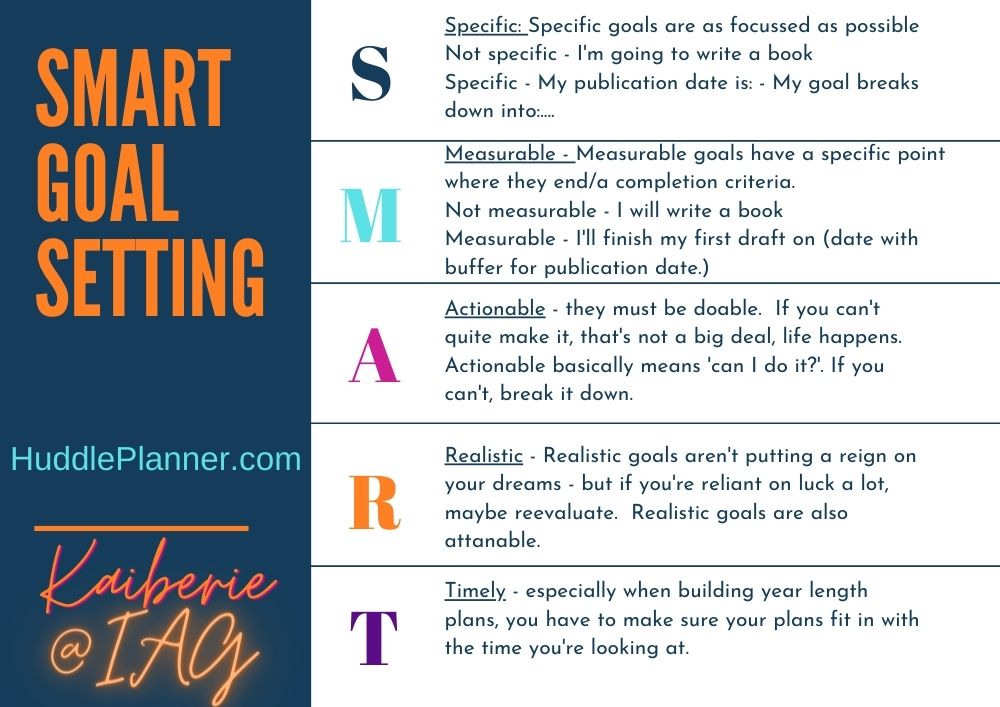
    Well, sort of. It’s pretty much a well-known fact that I live in a world of my own.  It’s a nice world, if a touch grim sometimes (though, like many people my post-apocalyptic game is way down), but I’m hoping to find my way back to my main world. I’m sure I will, but I’m working really hard on planning books and re-releasing.  I’m in an odd place as a writer – my backlist has completely expired back to me and I can choose to reboot everything, so the options really are endless for me.  But I’m also starting a brand new pen name, so I’ll be working as a new author, and building up from my actual platform too. So, this year, I’ll be sharing a lot of everything that I’m learning.  In fact, this month, I’m starting with newsletters. I do have goals too, but I’m trying hard to actually pin them SMART format.  Tying that to an ROI to boot is really difficult, especially when it’s something that’s not measurable by numbers, but I think if you set goals for yourself, you’ve got to find a way to measure them.

    Planning in my me-time

    The mistake I made last year was not planning some me time – I always told myself that I’d take my time off, but one thing or another came out, and even with everything that’s gone on in the last year – in fact, possibly because of it in some ways – I didn’t really take care of myself properly.  I’ve got meditation apps, and things to help me sleep, and I’ve still completely failed on that front.  Which is the last lesson thing I wanted to touch on – I’ve been seeing people talk about goals in terms of ‘I failed so…’ YOU DID NOT FAIL! (sorry, I didn’t mean to yell, but seriously). The dichotomy in the author community is writing *is* lonely, but then again, it isn’t.  We’ve got access to so many communities, but that leaves us open to so much, from poor influences that can throw us off, to seeing people where we want to be and feeling bad, to feeling intimidated and upset when things go badly.  And the thing is, even if we’ve put out lots, won awards, had a good time with people, we always seem to focus on the negative, so if you’re not setting goals, please take one thing from this post, and just think about the good, not the bad.  It’s important to focus on the good, always. That’s how we get through. We’ll be talking about SMART later this week again, and newsletters for the next little while so if you’ve got anything you’d like to share, then hit the comments.  Questions and requests, comments! And welcome to 2021.  No resolutions from me, but I do want to rock it, in any way I can, and know that with the community that IAG is, we can do almost anything. See you Saturday!
  • We’re back… :)

    We’re back… 🙂

    Well, the team have spoken, we’re updating the site, and there’s a lot of fun changes coming up.
    I thought today though, I’d share some of our best bits on the site.

    Resources for miles

    At the core of things at the Indie Author Group is our mission statement. Both Valerie Douglas and I felt, early on, supported by the rest of the team, that a safe space to get advice as an indie author. We don’t believe in judging others for their choices and are firmly all about making the most of everything. So, in 2011, when she set up the group, I was one of her first moderators, and we’ve gone on to build a really great resource. And we have an amazing team of moderators too!
    We founded the site late 2011, but the group will be 10 May 2021!

    What you can find in the group

    Honestly? A little of everything. We have resources that range from advice and support, to sharing information and tips and tricks. And a listing for the group’s Twitter list, Facebook pages, service providers (cover designers, editors, formatters, audiobooks, and more).
    If you’re not there already – why not? (tip, if you’re not, answer ALL the questions, and be aware we don’t allow advertising, at all, bar in communal documents for those reasons).

    So…there’s more? YES!

    So, we have other resources! Our pages are the main one – Indie Author Group, and we keep a page just for the blog, Indie Author Group Info.
    Then we’ve got the main blog (here).
    Then, there’s The Writer’s Information Reference Library – short answers for simple questions 🙂
    We’ll also be adding a tech page, a news page and more…
    Finally, we keep a newsletter, and Twitter 🙂

    Please check out our resources and let us know what you think!

  • Happy 9th Birthday IAG!

    Happy 9th Birthday IAG!

    Happy birthday to the Indie Author Group. Founded just as the trend of self-publishing took off by Valerie Douglas, and her co-founder Kai Viola, we are a vibrant team of writers and artists that look after one of the oldest communities for self-publishing and hybrid publishing on the Facebook.
    It’s our birthday today! We’ll be celebrating next week though, so watch the blog, group and page! (or the blog page!)
    To celebrate our 9th birthday, we’ll be overhauling, adding resources and doing a lot more, so watch this space!

  • How the three laws of robotics apply to writing and planning

    How the three laws of robotics apply to writing and planning

    Today is National Sci-Fi day, and while we’re not on Sci-fi this month (that’s later in the year) as our featured support genre, for advice Mondays, I thought I’d share a bit of a thought experiment.

    First though…

    Today would be Issac’s 100th birthday, and there’s little denying the impact he had on the world of sci-fi and writing. But the thing that always stuck with me the most was his three laws of robotics.

    The three laws

    (from Gismodo, who cites his story Runaround)

    1. A robot may not injure a human being or, through inaction, allow a human being to come to harm.

    2. A robot must obey the orders given to it by human beings, except where such orders would conflict with the First Law.

    3. A robot must protect its own existence as long as such protection does not conflict with the First or Second Law.

    Issac Asimov

    Later, Asimov added a fourth, or zeroth law, that preceded the others in terms of priority:

    0. A robot may not harm humanity, or, by inaction, allow humanity to come to harm.

    Issac Assimov

    I have many theories on AI, given I’m eventually doing a Ph.D. on it (hence the combined STEM degree now), but I’m not going to address the fallacies and intricacies of why the three laws (and the additional zero law, which is almost the same, but not quite, as law 1) fail and cause problems. If you want to know why there’s a plethora of books out there exploring that and similar issues.

    No, instead, I wanted to talk about how the three laws apply to writing.

    But I’m not a robot…

    As you’re quite right to observe, it’s highly unlikely that you are a robot. You might be, but then, that opens up questions, again, not for a writers’ blog. But when you look at the three laws of robotics and change the context to writing, something interesting happens.

    1. An author may not injure a human being or, through inaction, allow a human being to come to harm.
      I would argue this is common decency, but when there’s little of each online, it’s a good thing to bear in mind. It goes into a slightly broader concept though.
      While there’s no admonition to not harm our characters (cause we might), there is a duty in every community for the weakest to be cared for by the stronger. Writing is not a zero-sum game, so, if anything, I’d argue the first of the Writer’s three laws is that we need to work to prevent bullying. As we watch the mess with the RWA unfold and look back on Cockygate, I wonder why it isn’t a credo adopted by more.
      Beyond that, it also tells you not to hurt yourself. Planning and self-care are critical.
    2. An author must obey the rules of its community, except where such orders would conflict with the First Law.
      I think the easiest way to explain this one is 1) Don’t pick on someone for upholding rules on a group, even if you personally think they’re not fair. It’s their group, you agreed and continue to agree when you joined, and to be frank, bullying a moderator is something that we’re going zero tolerance on – and that includes if we *hear* of it from a friend that’s a mod. Beyond that, mob mentality is dangerous online – there’s a difference between defending the downtrodden and forming a lynching mob, and I think this law aptly states that. If an author is unhappy with a review and asks their tribe to retaliate, maybe question the worth of that tribe, and the person leading it?
    3. An author must protect its own existence as long as such protection does not conflict with the First or Second Law.
      Ah, you may say, doesn’t that mean if I don’t agree with people, I get to retaliate?
      Nope.
      You need to protect *your own existence*. What Jilly, Bob or Timmy does, as long as it’s not hurting you, isn’t important to you. I’m actually interpreting this one to be ‘don’t compare yourself to others, someone will get hurt’.

    Law 1, Kindness. Law 2, fair play and Law 3, personal obligation. All three make for the best writers and the best communities. Personal obligation does mean sticking up for the rights of others if you’re sure you should, but it also means accepting that you ‘do you’. One of the hardest lessons I learned last year was that if I’m not careful, I will stay away for too long because I have nothing to give. My personal obligation became to me and only me for a while, and that was ok. But I have an obligation to you guys too. So, Law 3…it could also be read as ‘help yourself, help others’.

    I don’t really agree that the zero law exists in the case of writers, but there is one final one I think all writers need to follow.

    Law 4 – An author must ensure that everything they put out reflects the best of their work and the best of them.
    Each and every one of the team knows
    it’s hard to get things done in a budget, and we all sacrifice, but we are calling each and every one of our members to consider their reputations this year. Build good things, save and make things to the best of your ability, and only release books when they are professionally edited, covered and formatted. That way, you’re already ahead of a lot of people out there, who might see your example and follow suit (thereby helping you with the second and third laws ;)).

    Yes, I belabored that one a bit, but I’m sure Asimov would forgive me.

    Do you agree with my three laws of writing? What would you add?

    January is National Braille month.
    Check out January’s Posts to see what we’ve covered.
  • Welcome to 2020! Let us help you make it your year! #IAG2020

    Welcome to 2020! Let us help you make it your year! #IAG2020

    IAG Happy New Year 2020

    Hi guys! I know it’s been a while that we’ve been writing regularly here, but we’ve got an actual editorial calendar and a plan now, and we’re back. Valerie and I will be blogging and we’ll be introducing the mods that are around, old and new, throughout the year. We’ll also be looking for guest posters, but I’ll explain more on that in a few days 🙂

    In 2011, Valerie Douglas put out a call for moderators. I think I was either first, or one of the first to say ‘I’ll help’. We’ve run this site, and others for almost as long, but we took a sabbatical last year, to think about what we wanted to do. And now….we’re back!

    But first….
    This year is a fun year for us. Not only are we NINE in May, but Valerie is a stone’s throw from 30 books, unless I miscounted, and that’d be funny cause I’m doing a Combined STEM degree, mostly maths. No, we’re not back in 2011, when this all started, but things are very similar again.

    So…to start with, we thought we’d invite you guys to share your goals. Same rules as always, you can use the link in the form that you fill in to make a comment, but any URLS in the comment bodies will be rejected.
    And if you’re not sure how to make goals, hang around this week – we’re doing a crash course on this, and some other stuff that might help.

    Quick tips to setting goals

    While I’ll be sharing many more articles on building yearly and five-yearly plans and your vision board for the decade, using free tools, the biggest and most important tip is that any goal you set (whether you call it a goal, a target, a resolution or where I’m going), is to be as specific as possible.
    Whether it’s “make six figures, five figures, four figures or three”, whether it’s to write a million, half a million or any range of words, whether it’s to publish 1-100 books, put a number on it, then tell *everyone*. Stick it in the sidebar of your blog if you have one. Put it on your Facebook, your Twitter, and check out our post on making an intentions post on Canva, on the 3rd.

    And, share it in the comments on the blog. We’ll be here, cheering you on.
    You’ve got this – and we’ve got you.
    Happy New Year, guys!

  • Submissions open!

    Submissions open!

    We are now taking guest posts for three of our blogs, and we’d love to see our readers and members join in.  If you’d like to guest post with us, all of the details are here!

    The main rule of submitting to the blogs are that they CANNOT be fluff, no use posts that promote you.  We are very keen to keep the quality of the blog high, therefore all posts should be your original content (we do accept reprints), with links to anything that you’re asserting that is to be backed up.  So, for example, if you say that ‘The Benevolent Dictator says that nothing sells one book like the next book’, it’d be brilliant if you could also link those words to the page (https://twirl.indieauthorgroup.com/selling-books/).  This means people can see where you’re learning from.  Please do not link YOUR OWN blog unless you are an expert – you’ve got your byline at the end for that.

    Main Guidelines

    Aside from no ads, we also ask that people do not use affiliate links.  If you link to Amazon books, we reserve the right to change the links to our own affiliate link, per our privacy guidelines.  We do ask, on the whole that you don’t write articles with Amazon links in if you can avoid it, to avoid issues of this kind.

    If you are linking to your own blog, we do ask that you link to specific posts, and that your own privacy guidelines are up to date.

    Your byline can contain three links – one of which should ideally be a blog, or other site for people to follow you.  We do not allow friend request links from Facebook – you must use a Facebook page.

    Finally, we reserve the right to reject any articles that don’t work for our site, or fits with our guidelines.  Full guidelines are of course listed here.
    Once you’ve read our guidelines, you can submit here.  The blog posts will then be taken to tech or marketing, or posted to the main blog as the team decides is right.
    Please ensure you include your email, your byline and any images when you submit.  We will not respond to return articles if we reject them, but we will of course let you know about accepted articles and your publication date.  If you do not hear back within six weeks of submission, please consider that your article has been rejected.

    We invite people to submit up to three posts.  We know the categories are odd on the form, don’t worry about that, but if we reject all three, we do ask that you look at our guidelines (which are clearly listed in our post here, on the guidelines and at the bottom of the form) and then wait a few months.

    Good luck, we’re really looking forward to seeing your submissions!

  • Pronoun is unfortunately closing

    Pronoun is unfortunately closing

    It’s always sad to see the demise of a platform that supports authors, and I heard (though never personally used) lots of great things about Pronoun.
    But it seems like they’re at the end of the road.

    Here’s part of the announcement.

    Two years ago Pronoun set out to create a one-of-a-kind publishing tool that truly put authors first. We believed that the power of data could be harnessed for smarter book publishing, leveling the playing field for indie authors.

    We are proud of the product we built, but even more so, we’re grateful for the community of authors that made it grow. Your feedback shaped Pronoun’s development, and together we changed the way authors connect with readers.

    Unfortunately, Pronoun’s story ends here.

    While many challenges in indie publishing remain unsolved, Macmillan is unable to continue Pronoun’s operation in its current form.

    You can read the whole piece here.