
“The greatest part of a writer’s time is spent in reading, in order to write. A man will turn over half a library to make a book.”
Samuel Johnson
“The greatest part of a writer’s time is spent in reading, in order to write. A man will turn over half a library to make a book.”
Samuel Johnson

Historically, writing is something that people consider to be really lonely and difficult, unless you’ve got a good community around you. But, in the last decade, especially, writing a book is more like raising children – it’s not solo, and really does take a village. And that was one of the principles that Indie Author Group was founded on. And we’ve talked about community before.
Honestly? There are so many answers to this question, but the key answer has to be that as humans we’re social creatures. Writing is about connecting to another person, so why not make sure you’re connected when writing. And there’s a saying that we oft quote in the group – a rising tide lifts all boats.
No matter what the size of the boat, the community feeling and learning is always about making sure everyone is making the most of their lives. And if they aren’t, hopefully we can help.
It’s also about the fact that writing is done by ‘fleet’. That is, readers will see one ‘boat’ (book) and go for others. It’s just another way of saying we’re not zero sum in the community. It’s not about one person having ALL of the readers, and more about ensuring that people can read and be happy.
Community isn’t just about reading books though, and it’s not just about writing – it’s about sharing knowledge. And if you can learn from and support others in learning from mistakes, either that you’ve made or nearly made, that’s a kindness in the community that can’t be understated.
~D Kai Wilson-Viola
During the pandemic, community became one of the single most important things to many people – connection, love, support, it was all there. And I think it says a lot about the state of mental health that this is still the case. And it doesn’t matter if you’re formally diagnosed with a mental or physical health concern, the writing community is all access, all ability, all support.
So, you’re a writer, dipping your toe in looking for your community? As I said earlier in the article, we should consider it as a village, and how it takes a village to do everything. You could argue that before self-publishing took off, we found our villages by going to traditional publishers. Now, in many ways, we get to build our own villages, virtually and by connecting with the best we can access.
But how can you access that community?
There’s various things you can do!
I’ve broken down the ones that I find most useful – please remember though, you need to tailor it to your own needs and beliefs. I say this because I use some social media and not others.
By far and away, Facebook and Twitter are the best places for me to have a community that I can share with, and I lead one on my blogs. I’m never lonely, I’ve always got places I can ask questions and I’m always motivated by other writers, while trying to support them too!
Recently, a new author approached us and told us that they were completely lost after being told they needed to establish a brand – they’d spent months and months looking at all of the studies of how to be an author. It talked about leveraging thousands of people on a list, pre-launching your pre-orders and propelling them into the charts using your following, and only using social media to buy advertising. Your brand is how your readers perceive you, you can’t control that, don’t even try. (I have to emphasize, if this is taken out of context, I DO NOT agree with this!).
Oh…and engage, engage, engage. Even on reviews.
None of this is good advice, not in my opinion.
Brand isn’t a maybe if you’re an author. Your brand isn’t something that others shape either – it’s your individual and unique stamp. Your garuantee of quality. YOUR reputation in the reading community. So your brand should be something that’s not only carefully cultivated, but carefully considered.
Many authors start after they’ve launched books, and that’s ok, but it really is best to get started as soon as you commit to the idea of being a published author. The longer you have to develop a cohesive brand, and start impressing people with that brand, so they link to your books via your brand.
Brand is complicated, but you can make it easier by breaking it down into what you consider essential, what you consider to be secondary, and what you consider to be not essential. And a lot of that does come down to where (a) you are comfortable, and (b) where your readers are. Balancing both allows you to decide where to work on your brand.
What options do I have?
We’ll be talking about it in the coming weeks and months, but anywhere readers gather is potentially a place to hang out. But brand isn’t (just) advertising – in fact, in my opinion, advertising is only a small part of it. I believe the key to brand is authenticity.. It’s interaction. One of the major rules that we absolutely stick by on the Indie Author Group is that we follow the *social* in Social Media. Readers might remember things they’ve seen over and over again, and while brand and consistency is about memorability, would you rather be remembered because all you’ve done is talk about your books, or beacuse you’ve given back to the community. I’d prefer the latter, wouldn’t you?
We’ll be talking platforms in the coming weeks, but myself? I focus (in order) on:
My own blogs, my own newsletter, guest posting, support groups on Facebook, my own groups on Facebook, Twitter, Instagram, Bookbub, Goodreads. I keep an eye on other places too, but that’s my order. Your milage may vary, and before I set up my own sites, I was a lot more active on places like Facebook and Twitter.
So….think about where your readers and genre are, and where you’re happiest, and build your community. Use sites that aren’t fully in your control to funnel people back to your own blog, and share items that you create.
And it’s not to say ‘don’t talk about your work’. Just keep it proportional.
And remember – we’re a community. Your brand should always reflect generosity. Share others, support others, write up the things you’ve learned and pay it forward. Your brand is something that will live with your pen name, always, so you can create something amazing, lasting and incredible, simply by building what you need from your community, and designing support for those around you. That’s the brand we’ve tried to build with IAG, and the brand all of the team of moderators and regulars believe in. And you’re welcome to come enjoy that brand, and learn from us too.
Next week, I’ll talk about options for blogging – if you’ve got questions, let me know!

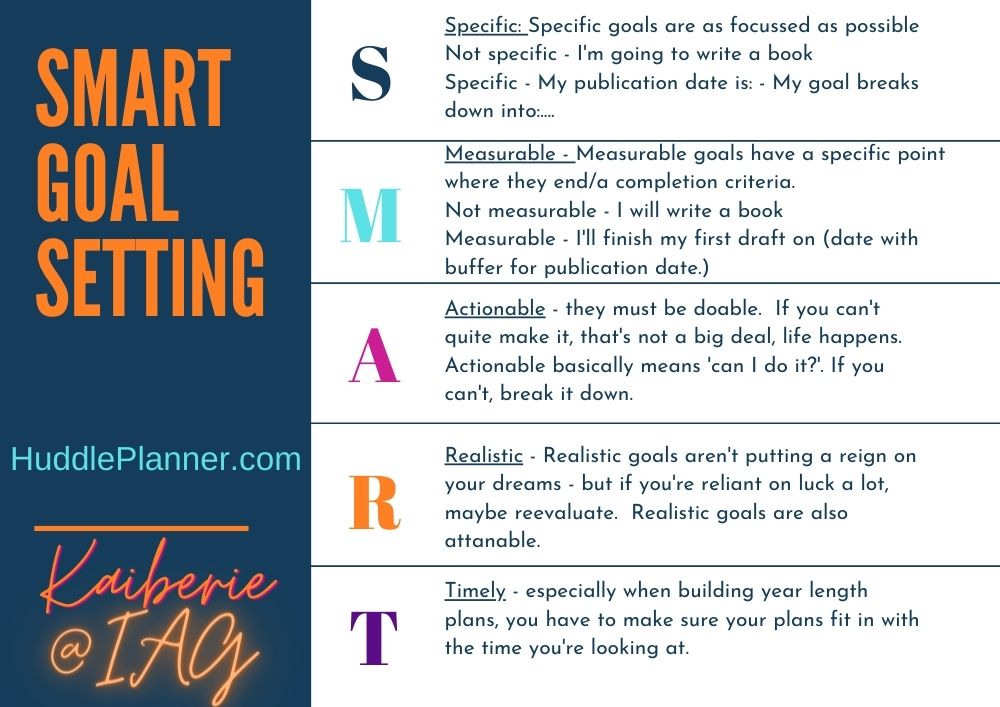 I do have goals too, but I’m trying hard to actually pin them SMART format. Tying that to an ROI to boot is really difficult, especially when it’s something that’s not measurable by numbers, but I think if you set goals for yourself, you’ve got to find a way to measure them.