One of the best things about community is that when you are stuck, chances are someone knows the answer. In the indie author commumity, it’s often easy to forget that others have paved the way before you, that writing is a solitary pursuit. Right?
Category: op-eds
-
To goal or not to goal?
Hi guys! It’s a whole new year, and we’re planning all sorts of good things for you, but today, I wanted to touch on goals.Back to…
Today seems to be the day for us to all be back at ‘work/writing/life’. The holidays, however, they were, are over and I’m on the fence about whether to goal or not to goal. I do, but I know others on the team don’t, so I thought I’d talk about how I’m organising my year, and if you’d like to share yours in the comments I’d love to hear from you!Back to life, back to reality
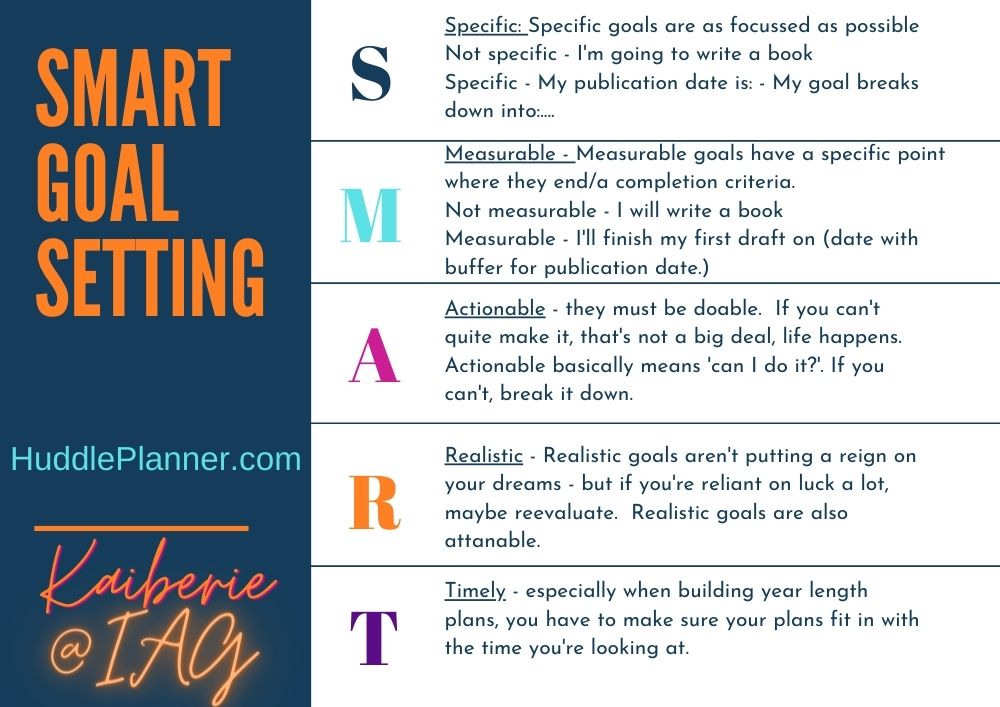
Well, sort of. It’s pretty much a well-known fact that I live in a world of my own. It’s a nice world, if a touch grim sometimes (though, like many people my post-apocalyptic game is way down), but I’m hoping to find my way back to my main world. I’m sure I will, but I’m working really hard on planning books and re-releasing. I’m in an odd place as a writer – my backlist has completely expired back to me and I can choose to reboot everything, so the options really are endless for me. But I’m also starting a brand new pen name, so I’ll be working as a new author, and building up from my actual platform too. So, this year, I’ll be sharing a lot of everything that I’m learning. In fact, this month, I’m starting with newsletters.I do have goals too, but I’m trying hard to actually pin them SMART format. Tying that to an ROI to boot is really difficult, especially when it’s something that’s not measurable by numbers, but I think if you set goals for yourself, you’ve got to find a way to measure them.
Planning in my me-time
The mistake I made last year was not planning some me time – I always told myself that I’d take my time off, but one thing or another came out, and even with everything that’s gone on in the last year – in fact, possibly because of it in some ways – I didn’t really take care of myself properly. I’ve got meditation apps, and things to help me sleep, and I’ve still completely failed on that front. Which is the last lesson thing I wanted to touch on – I’ve been seeing people talk about goals in terms of ‘I failed so…’ YOU DID NOT FAIL! (sorry, I didn’t mean to yell, but seriously). The dichotomy in the author community is writing *is* lonely, but then again, it isn’t. We’ve got access to so many communities, but that leaves us open to so much, from poor influences that can throw us off, to seeing people where we want to be and feeling bad, to feeling intimidated and upset when things go badly. And the thing is, even if we’ve put out lots, won awards, had a good time with people, we always seem to focus on the negative, so if you’re not setting goals, please take one thing from this post, and just think about the good, not the bad. It’s important to focus on the good, always. That’s how we get through. We’ll be talking about SMART later this week again, and newsletters for the next little while so if you’ve got anything you’d like to share, then hit the comments. Questions and requests, comments! And welcome to 2021. No resolutions from me, but I do want to rock it, in any way I can, and know that with the community that IAG is, we can do almost anything. See you Saturday! -

We’re back… 🙂
Well, the team have spoken, we’re updating the site, and there’s a lot of fun changes coming up.
I thought today though, I’d share some of our best bits on the site.Resources for miles
At the core of things at the Indie Author Group is our mission statement. Both Valerie Douglas and I felt, early on, supported by the rest of the team, that a safe space to get advice as an indie author. We don’t believe in judging others for their choices and are firmly all about making the most of everything. So, in 2011, when she set up the group, I was one of her first moderators, and we’ve gone on to build a really great resource. And we have an amazing team of moderators too!
We founded the site late 2011, but the group will be 10 May 2021!What you can find in the group
Honestly? A little of everything. We have resources that range from advice and support, to sharing information and tips and tricks. And a listing for the group’s Twitter list, Facebook pages, service providers (cover designers, editors, formatters, audiobooks, and more).
If you’re not there already – why not? (tip, if you’re not, answer ALL the questions, and be aware we don’t allow advertising, at all, bar in communal documents for those reasons).So…there’s more? YES!
So, we have other resources! Our pages are the main one – Indie Author Group, and we keep a page just for the blog, Indie Author Group Info.
Then we’ve got the main blog (here).
Then, there’s The Writer’s Information Reference Library – short answers for simple questions 🙂
We’ll also be adding a tech page, a news page and more…
Finally, we keep a newsletter, and Twitter 🙂Please check out our resources and let us know what you think!
-

How the three laws of robotics apply to writing and planning
Today is National Sci-Fi day, and while we’re not on Sci-fi this month (that’s later in the year) as our featured support genre, for advice Mondays, I thought I’d share a bit of a thought experiment.
First though…
We’re a nation – or half of one – proud of our ignorance https://t.co/3I5AMHu7Ia
— Valerie Douglas #fantasy #thriller #romance (@ValerieDouglasA) January 2, 2020Today would be Issac’s 100th birthday, and there’s little denying the impact he had on the world of sci-fi and writing. But the thing that always stuck with me the most was his three laws of robotics.
The three laws
(from Gismodo, who cites his story Runaround)
1. A robot may not injure a human being or, through inaction, allow a human being to come to harm.
2. A robot must obey the orders given to it by human beings, except where such orders would conflict with the First Law.
3. A robot must protect its own existence as long as such protection does not conflict with the First or Second Law.
Issac AsimovLater, Asimov added a fourth, or zeroth law, that preceded the others in terms of priority:
0. A robot may not harm humanity, or, by inaction, allow humanity to come to harm.
Issac AssimovI have many theories on AI, given I’m eventually doing a Ph.D. on it (hence the combined STEM degree now), but I’m not going to address the fallacies and intricacies of why the three laws (and the additional zero law, which is almost the same, but not quite, as law 1) fail and cause problems. If you want to know why there’s a plethora of books out there exploring that and similar issues.
No, instead, I wanted to talk about how the three laws apply to writing.
But I’m not a robot…
As you’re quite right to observe, it’s highly unlikely that you are a robot. You might be, but then, that opens up questions, again, not for a writers’ blog. But when you look at the three laws of robotics and change the context to writing, something interesting happens.
- An author may not injure a human being or, through inaction, allow a human being to come to harm.
I would argue this is common decency, but when there’s little of each online, it’s a good thing to bear in mind. It goes into a slightly broader concept though.
While there’s no admonition to not harm our characters (cause we might), there is a duty in every community for the weakest to be cared for by the stronger. Writing is not a zero-sum game, so, if anything, I’d argue the first of the Writer’s three laws is that we need to work to prevent bullying. As we watch the mess with the RWA unfold and look back on Cockygate, I wonder why it isn’t a credo adopted by more.
Beyond that, it also tells you not to hurt yourself. Planning and self-care are critical. - An author must obey the rules of its community, except where such orders would conflict with the First Law.
I think the easiest way to explain this one is 1) Don’t pick on someone for upholding rules on a group, even if you personally think they’re not fair. It’s their group, you agreed and continue to agree when you joined, and to be frank, bullying a moderator is something that we’re going zero tolerance on – and that includes if we *hear* of it from a friend that’s a mod. Beyond that, mob mentality is dangerous online – there’s a difference between defending the downtrodden and forming a lynching mob, and I think this law aptly states that. If an author is unhappy with a review and asks their tribe to retaliate, maybe question the worth of that tribe, and the person leading it? - An author must protect its own existence as long as such protection does not conflict with the First or Second Law.
Ah, you may say, doesn’t that mean if I don’t agree with people, I get to retaliate?
Nope.
You need to protect *your own existence*. What Jilly, Bob or Timmy does, as long as it’s not hurting you, isn’t important to you. I’m actually interpreting this one to be ‘don’t compare yourself to others, someone will get hurt’.
Law 1, Kindness. Law 2, fair play and Law 3, personal obligation. All three make for the best writers and the best communities. Personal obligation does mean sticking up for the rights of others if you’re sure you should, but it also means accepting that you ‘do you’. One of the hardest lessons I learned last year was that if I’m not careful, I will stay away for too long because I have nothing to give. My personal obligation became to me and only me for a while, and that was ok. But I have an obligation to you guys too. So, Law 3…it could also be read as ‘help yourself, help others’.
I don’t really agree that the zero law exists in the case of writers, but there is one final one I think all writers need to follow.
Law 4 – An author must ensure that everything they put out reflects the best of their work and the best of them.
Each and every one of the team knows it’s hard to get things done in a budget, and we all sacrifice, but we are calling each and every one of our members to consider their reputations this year. Build good things, save and make things to the best of your ability, and only release books when they are professionally edited, covered and formatted. That way, you’re already ahead of a lot of people out there, who might see your example and follow suit (thereby helping you with the second and third laws ;)).Yes, I belabored that one a bit, but I’m sure Asimov would forgive me.
Do you agree with my three laws of writing? What would you add?

Check out January’s Posts to see what we’ve covered. - An author may not injure a human being or, through inaction, allow a human being to come to harm.